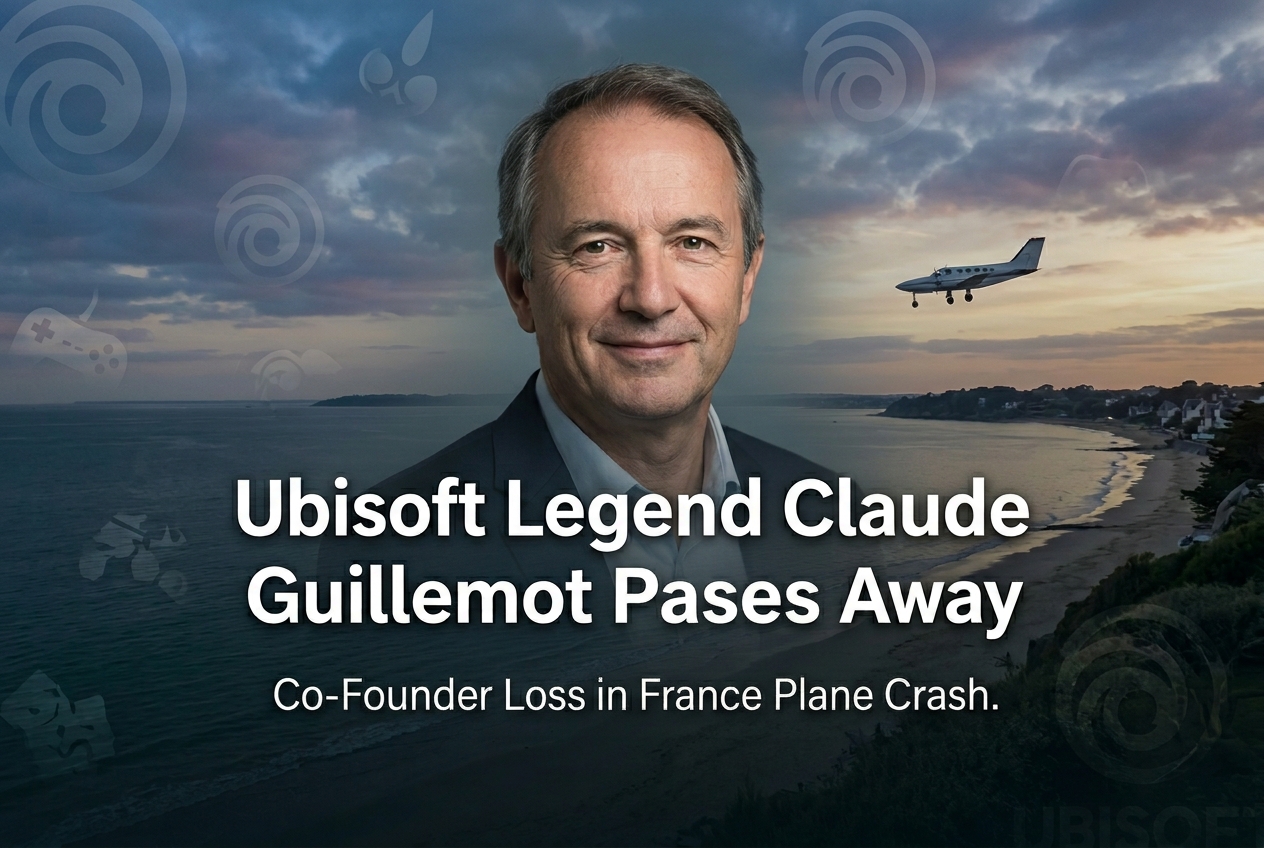
Claude Guillemot, one of the five brothers who co-founded Ubisoft in 1986, died at age 69 when his Cessna 421 crashed near La Baule in western France on June 19, 2026. Here is what we know about the crash and Guillemot’s legacy.
Claude Guillemot, one of the five brothers who co-founded French video game giant Ubisoft in 1986, died on Friday, June 19, 2026, when a twin-engine Cessna 421B Golden Eagle he was piloting crashed into a wheat field near La Baule-Escoublac airfield in western France. He was 69 years old. A flight instructor identified by French media as Marc Guillet was also killed in the crash. French aviation authorities have launched a formal investigation into the cause of the accident.
What Happened at La Baule?
According to regional outlet Ouest-France, which first broke the story, the eight-seat Cessna 421 departed from Rennes at approximately 5:25 p.m. local time. About 25 minutes later, shortly before 6:00 p.m., the aircraft went down while on its landing approach to La Baule-Escoublac airfield in the Loire-Atlantique department. La Baule Mayor Franck Louvrier told French broadcaster ICI that witnesses saw the plane “bank suddenly and crash.”
The aircraft burst into flames on impact, setting fire to surrounding vegetation. Around 60 firefighters were dispatched to the scene. The intensity of the blaze made identifying those on board extremely difficult and delayed formal confirmation of the victims. Both people aboard were confirmed dead at the scene by Loire-Atlantique fire services.
Investigative sources cited by Le Figaro indicated that Guillemot was at the controls of the aircraft at the time of the crash. French authorities have not yet determined whether the cause was mechanical failure, weather conditions, or another factor. Guillemot was a member of the La Baule flying club and owned the Cessna. He was reportedly en route to an aviation gathering that weekend, an event expected to draw more than 100 aircraft to the area.
Who Was Claude Guillemot?
Born on October 30, 1956, in the small Breton village of Carentoir, Claude Guillemot was the eldest of the five Guillemot brothers. The family originally ran an agricultural trading business, but when profit margins in farming shrank, the brothers looked for ways to diversify. In the early 1980s, Claude discovered that their French supplier was charging twice what the same software cost at retail in the United Kingdom. That gap became a business opportunity: by 1984, the brothers had launched a mail-order company selling computers and video games.
On March 28, 1986, Claude, along with Yves, Michel, Gérard, and Christian Guillemot, formally incorporated Ubi Soft Entertainment S.A. The company started by distributing games and quickly moved into development. Its 1995 release of Rayman for the original PlayStation marked a turning point, and Ubisoft went on to create some of the most iconic franchises in gaming history: Assassin’s Creed, Far Cry, Rainbow Six, Prince of Persia, Watch Dogs, and Just Dance, among others.
The Operational Backbone Behind Ubisoft
While his brother Yves served as Ubisoft’s public-facing CEO for decades, Claude operated largely behind the scenes. He sat on Ubisoft’s board of directors and held the title of Executive Vice President in charge of operations, later also serving as Deputy CEO. His deep knowledge of gaming technology for PCs, consoles, and accessories, combined with extensive experience in Asia where he lived for a period, made him a pivotal figure in shaping the company’s global strategy.
Beyond Ubisoft itself, Claude was chairman and CEO of Guillemot Corporation, the family’s publicly traded holding company. Guillemot Corp. owns Thrustmaster, one of the world’s leading manufacturers of gaming peripherals including racing wheels, flight sticks, and controllers, as well as Hercules, known for audio and DJ equipment. Under Claude’s leadership from 1997 onward, the company expanded with R&D and logistics centres across Europe, Canada, and China. In June 2025, the CEO role at Guillemot Corp. was handed to Valentin Guillemot, though Claude continued as chairman of the board.
He also served as president of the Club des Trente since 2009, an association bringing together 60 French CEOs for discussions on socio-economic issues, extending his influence well beyond the gaming industry.
Ubisoft’s Official Response
Ubisoft confirmed Guillemot’s death in a brief statement released on Saturday, June 20: “Ubisoft was deeply saddened to learn of the death of Claude Guillemot, co-founder of the group and chairman of Guillemot Corp., in an accident. Our thoughts are with his family and loved ones during this difficult time.” The company stated that no further comment would be made. Across the gaming industry and on social media, tributes and condolences poured in from developers, executives, and players alike.
Ubisoft in the Middle of Its Most Difficult Chapter
Guillemot’s death arrives during one of the most turbulent periods in Ubisoft’s nearly 40-year history. The company recently reported a record annual operating loss of approximately 1.3 billion euros (around $1.5 billion) for its 2025-26 fiscal year. Net bookings fell 17.4 percent to just over 1.5 billion euros. A sweeping restructuring announced in January 2026 saw seven titles cancelled, six delayed, and studios in Halifax and Stockholm shut down entirely. Over 3,000 positions have been eliminated across two years, and the company is targeting an additional 200 million euros in cost reductions by March 2028.
CEO Yves Guillemot acknowledged the pain of the transition: “This two-year transformation comes with difficult decisions and a disappointing short-term financial performance.” He warned that the 2026-27 fiscal year would be a “low point,” with net bookings expected to decline by a further 8-9 percent and a negative operating margin in the high single digits. Ubisoft is reorganising its global studios into five specialised “creative houses,” each focused on a distinct genre.
Despite the financial headwinds, the company is pushing forward with key releases. Assassin’s Creed Black Flag Resynced, a ground-up remake of the beloved 2013 title built on the latest Anvil engine, is scheduled to launch on July 9, 2026. The Assassin’s Creed, Far Cry, and Rainbow Six franchises have been grouped under a newly formed entity called Vantage Studios, which has drawn investment from Tencent. Ubisoft has indicated it expects a “meaningful rebound” from 2027 onward.
A Pilot and an Aviation Enthusiast
Outside the boardroom, Claude Guillemot was a passionate aviator. He was an active member of the La Baule flying club and owned the Cessna 421B Golden Eagle involved in the crash, a well-regarded twin-engine propeller aircraft widely used across Europe for private travel. On the day of the accident, he was flying to La Baule to attend an airshow that was set to take place that weekend. The Cessna 421 is considered a reliable aircraft type, making the precise circumstances of the crash all the more critical for investigators to determine.
The Legacy of a Quiet Architect
Claude Guillemot was not the brother whose name appeared in headlines or on stage at E3 presentations. His role was structural, operational, and strategic. He helped turn a mail-order software business run from a Breton farmhouse into a company with over 20,000 employees, more than 50 studios worldwide, and some of the best-selling entertainment franchises on the planet. Through Guillemot Corporation, he also shaped the gaming hardware landscape with Thrustmaster peripherals used by millions of sim racing and flight sim enthusiasts.
The five Guillemot brothers built their empire together, each taking responsibility for a different arm of the family’s business interests. Claude’s domain was operations and hardware. His death at 69 leaves a significant void in both Ubisoft’s founding legacy and the broader European gaming industry. The companies he helped build, the brands he led, and the franchises he helped bring into existence will endure as the most tangible evidence of his four decades of work.