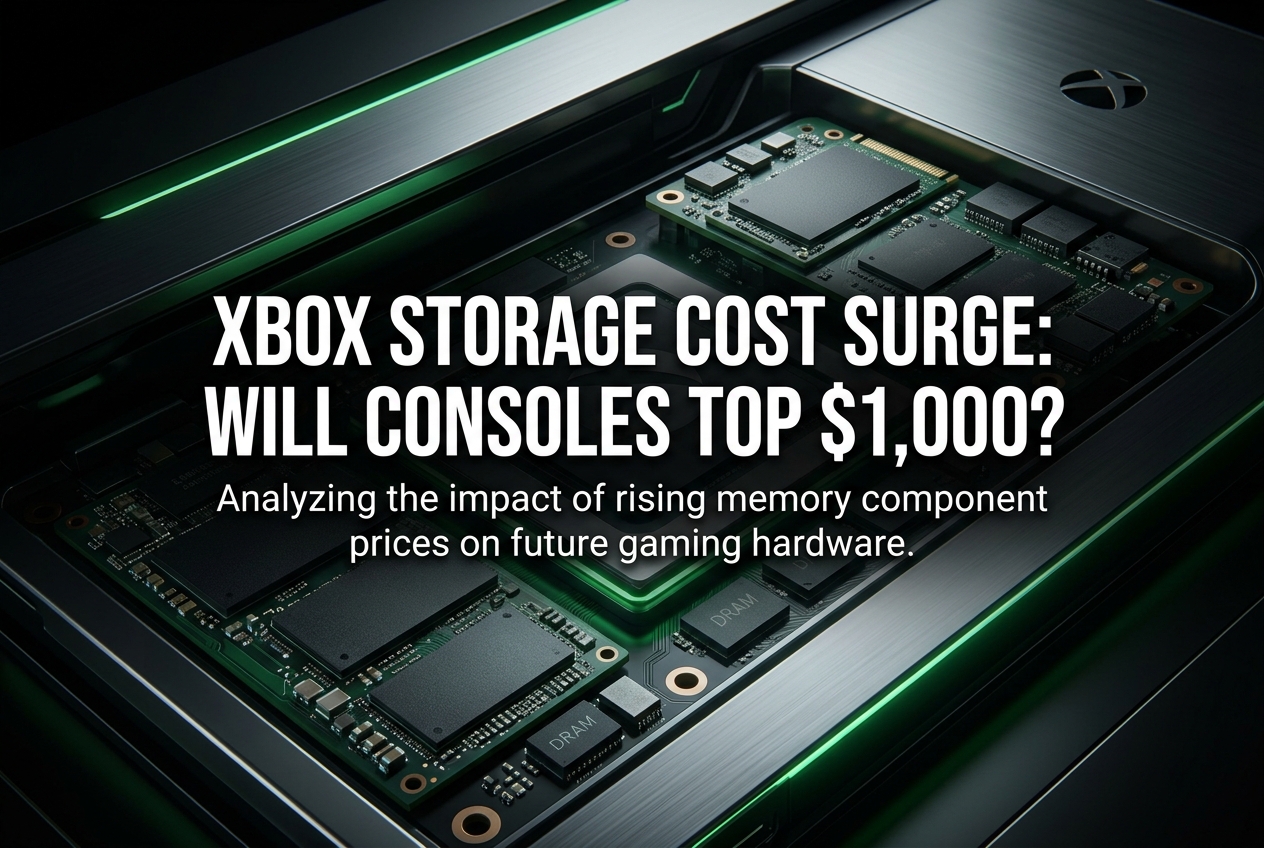
Xbox CEO Asha Sharma disclosed that storage component costs will surge over 5x by the 2027 holiday season. Project Helix may exceed $1,000 as the company explores new business models amid a global memory crisis.
Xbox will close its current fiscal year with roughly a 3% profit margin after investing over $20 billion in content, platform, and hardware subsidies across five years while watching annual revenue decline by nearly $500 million. These figures come directly from a public memo titled “Xbox Reset,” co-authored by CEO Asha Sharma and Chief Content Officer Matt Booty on June 10, 2026. At the centre of the crisis sits a global memory and storage shortage, driven largely by AI infrastructure demand, that is rewriting console economics for the entire industry.
How Bad Is the Component Cost Surge?
When Asha Sharma joined as Xbox CEO in February 2026, the price Xbox paid for console storage components was already more than double what it had been the previous autumn. Those costs have since doubled again. By the 2027 holiday season, Xbox projects it will pay over five times the prices from just two years earlier. Memory costs have followed a broadly similar trajectory, according to the memo published on Xbox Wire.
Wedbush analysts Matt Bryson and Antoine Legault put the numbers in sharper perspective: client SSD NAND that ran 5 to 6 cents per gigabyte as recently as the second half of 2025 now sits closer to $0.30 per gigabyte. On their estimates, that adds roughly $250 in storage cost to a 1 TB Xbox Series X (a $650 console) and $500 to the 2 TB Special Edition ($800). The Wedbush team described the Xbox memo as “a clear sign that the memory and NAND shortage is rewriting consumer hardware economics, not just trimming margins.”
Why Are Memory Prices Exploding?
The root cause is the insatiable demand for DDR5 and HBM memory from AI data centres. Microsoft itself is one of the largest contributors to this demand, with a projected $190 billion in capital expenditure for 2026 to expand its AI infrastructure. Counterpoint Research reported that DRAM prices rose approximately 50% across 2025, with an additional 30% spike in the final quarter alone. Micron Technology’s decision to exit the consumer memory market by 2026, despite supplying roughly 30% of global RAM, further tightened supply.
CCS Insight chief analyst Ben Wood stated that memory prices for consumer electronics have doubled over the last two quarters and continue to climb. New production capacity is not expected to meaningfully alleviate constraints until well into 2027 and possibly into early 2028. The irony is hard to miss: Microsoft’s own AI spending is one of the forces driving up the costs that are crippling its gaming division.
What Does This Mean for Project Helix Pricing?
No official price has been confirmed for Xbox’s next-generation console, codenamed Project Helix. However, analyst estimates converge around a range of $850 to well over $1,000. Dr. Serkan Toto of Kantan Games suggested a starting price of $900 scaling upward. Rhys Elliott of Alinea Analytics placed the floor at $850, noting that the PS5 Pro already pushed premium hardware pricing ceilings and that the current Series X sits at $650. Moore’s Law is Dead, a well-connected tech insider channel, estimated a probable price of $1,000 or more, potentially reaching $1,200 to $1,500.
The hardware driving these costs is formidable. Project Helix is expected to feature a custom AMD Magnus processor and next-generation RDNA5 graphics architecture, delivering roughly five times the standard visual processing performance of the current Xbox Series X and a claimed 20x improvement in ray tracing. The GPU component alone is estimated to cost around $550 in manufacturing. When combined with surging memory prices, total production cost approaches $900, making a sub-$1,000 retail price difficult to achieve without significant subsidies.
Is Project Helix Still a Console or a Luxury Device?
Tom’s Hardware’s analysis characterised Helix as having moved past affordable console territory into luxury device positioning. The console-PC hybrid approach that Microsoft has adopted pushes the price firmly into four-figure territory. CEO Sharma herself has acknowledged that spending thousands of dollars in a single console generation is not feasible for most players.
For context, a PS5 Pro now costs $900 and a 1 TB Steam Deck OLED runs $950. In that landscape, a Helix above $1,000 might not seem as extreme when measured against the generational leap it promises. Still, it marks a dramatic departure from the console pricing norms that defined previous generations, where launch prices typically ranged from $400 to $600.
Reports suggest Microsoft is also exploring a more affordable companion device. Some speculation points to the Xbox Series S being repositioned as a budget bridge into the next generation at a $200 price point, ensuring that cost-conscious gamers are not priced out entirely.
The Xbox Reset: A 100-Day Overhaul
The financial picture behind the reset is stark. Excluding the $75 billion Activision Blizzard King acquisition, Xbox spent over $20 billion on content, platform, and hardware subsidies across the past five years, yet annual revenue declined by nearly half a billion dollars during the same period. The division’s accountability margin (the percentage of revenue retained as profit) sits at approximately 3%, down year over year.
Bloomberg reported on June 10 that significant layoffs are planned for shortly after Microsoft’s fiscal year closes on June 30, 2026. The exact headcount has not been confirmed, but industry discussions cite a figure of approximately 1,000 roles. Marketing budgets face significant cuts, and studio closures have not been ruled out. If the cuts materialise, it will mark the fourth consecutive year of major Xbox layoffs, following the July 2025 wave that was part of a 9,100-person Microsoft-wide reduction.
Sharma and Booty acknowledged in the memo that Xbox’s studio system expanded to serve “multiple strategies across subscription, streaming, and devices” and became “overextended” in the process. Flagship franchises were “not adequately funded to compete and win,” a candid admission of why the division’s heavy content investment failed to generate proportionate returns.
New Business Models: What Could Change?
The Reset memo references a need for “new business models and partnerships for hardware.” This language points to several potential directions:
- Third-party OEM manufacturing: Outsourcing console production to offset costs that would otherwise require subsidising hardware at a loss.
- Expanded subscription tiers: Deeper integration of Game Pass, cloud gaming, and financing plans to reduce the upfront cost barrier for players.
- Flexible storage offerings: The memo specifically mentions exploring consoles with lower base storage, potentially combined with cloud-based game streaming to reduce the need for expensive onboard NAND.
- Hardware partnerships: Deeper collaboration with partners like ASUS, which already produces the ROG Xbox Ally X handheld priced at $999.
On the Game Pass front, Sharma has already reduced the price of Game Pass Ultimate in the US from $29.99 to $22.99 per month. The trade-off: Call of Duty titles will no longer appear on the service at launch, instead arriving approximately one year after release. PC Game Pass pricing has also decreased. These moves signal a shift toward sustainability over aggressive subscriber growth.
Xbox Exclusives Are Returning
Amid the financial reset, Xbox is partially reversing its multi-platform strategy. Gears of War: E-Day will launch in 2026 and Clockwork Revolution in 2027 as Xbox console exclusives. Sharma stated these are “not timed exclusives,” meaning they will not eventually appear on competing platforms. However, major multiplayer and live-service games will remain multi-platform.
The exclusivity pivot is designed to strengthen Xbox’s platform identity and give console owners tangible reasons to stay within the ecosystem. With only two confirmed exclusives across 2026 and 2027, however, the pipeline remains thin compared to competitors. Sony’s PlayStation continues to leverage heavy-hitting exclusives, with Marvel’s Wolverine expected as a platform exclusive later this year.
Is the Memory Crisis Affecting the Entire Industry?
Yes. The component cost crisis extends far beyond Xbox. Sony has stated that PlayStation 6’s price and launch window remain undecided due to ongoing RAM shortages. The Telegraph reported that PS6 could be delayed to 2028 or even 2029 if supply does not stabilise. Analysts broadly forecast that next-generation consoles will launch at prices at least 50% higher than their predecessors. NYU professor Joost van Dreunen described $1,000 consoles as “the new normal.”
Valve’s Steam Machine project has also been affected. At GDC, Valve publicly joked, “If you have a line on a bunch of RAM, we are in the market and would like to buy it,” underscoring the severity of the shortage. Even PC gamers are not immune: 64 GB DDR5-6000 RAM kits that sold for $205 to $220 a few months ago have risen to $599 or more at retail.
What This Means for Gamers Right Now
The practical implications for players break down into several areas:
- Current console prices may rise again. With storage costs adding hundreds of dollars to manufacturing bills, further price increases for the Xbox Series X and S lineup are widely expected in 2026.
- Next-gen consoles will be expensive. Both Project Helix and PS6 are projected to launch between $850 and $1,200, depending on component costs at the time of production.
- Supply may be constrained. Sharma explicitly stated that Xbox currently cannot manufacture as many consoles as players want to buy. This production bottleneck could persist through the 2027 holiday season.
- Subscription services gain importance. As hardware costs climb, cloud gaming and Game Pass-style subscriptions offer a lower barrier to entry for budget-conscious gamers.
- Game prices are rising too. First-party Xbox titles now carry an $80 price tag, a trend expected to spread across the industry by 2026.
Things Worth Knowing
When is Project Helix expected to launch?
AMD CEO Lisa Su confirmed that the next Xbox will be on shelves in 2027. The 2027 holiday season is the widely expected target. However, some analysts caution that persistent memory shortages could push the launch to 2028 if component availability does not improve.
Will Xbox Series X get another price increase?
It is considered likely. Wedbush’s analysis shows that soaring NAND costs have added $250 or more to the manufacturing cost of a 1 TB Series X. Microsoft has already raised console prices multiple times since 2025, and the ongoing memory crisis makes additional increases difficult to avoid.
Could the memory crisis ease before 2027?
Some industry sources suggest that AI-driven demand for consumer-grade memory may begin to subside by late 2027 as dedicated AI memory production scales up. However, analysts at CCS Insight and Counterpoint do not expect meaningful relief until 2027 at the earliest, with some projecting constraints into 2028.
Is Microsoft responsible for the memory crisis it is complaining about?
Partially. Microsoft’s projected $190 billion in AI-related capital expenditure for 2026 makes it one of the largest drivers of the very component demand that is inflating Xbox’s costs. Tom’s Hardware described the situation as “a bit ironic,” noting that Microsoft is simultaneously one of the biggest constituents of the AI boom and one of its most visible victims in the consumer hardware space.