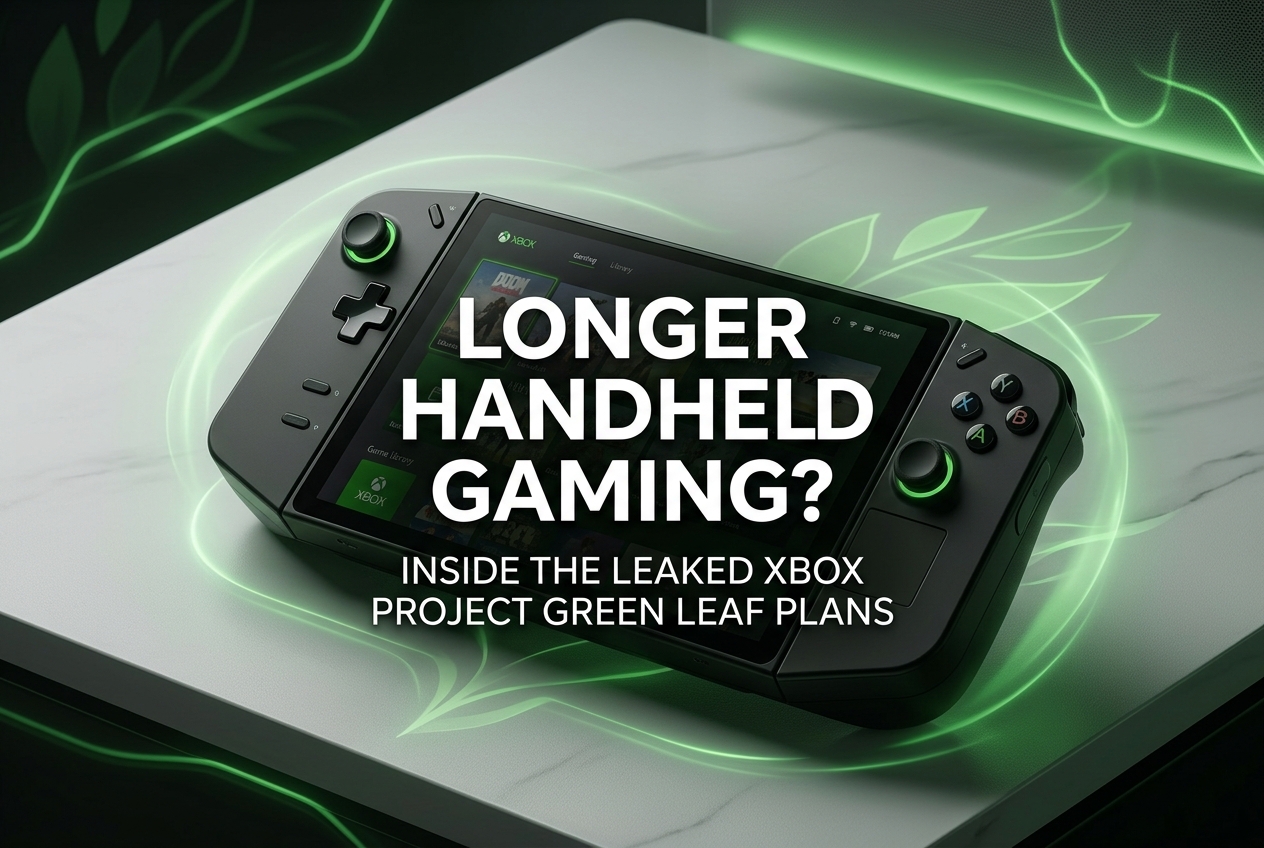
Microsoft’s leaked Project Green Leaf initiative integrates PO and PO+ power optimization modes directly into the Xbox GDK, promising up to 30% longer battery life for Windows-based gaming handhelds without sacrificing gameplay performance.
Microsoft is building a software-driven power optimization framework called Project Green Leaf directly into the Xbox Game Development Kit (GDK), targeting up to 30% longer battery life on Windows-based gaming handhelds. Leaked internal documents shared by hardware leaker Moore’s Law Is Dead on 8 May 2026 reveal two new power profiles, internal benchmark data showing up to 36% energy savings in tested titles, and a planned rollout as early as May or June 2026.
What Is Project Green Leaf?
Project Green Leaf is not a single hardware feature or a simple firmware toggle. According to leaked partner documentation, it is a developer-facing optimization framework embedded in the Xbox GDK. The system introduces two distinct power profiles that developers integrate into their games:
- Power Optimized (PO): Activates during moments where full performance is unnecessary. When a player is idle, browsing menus, sitting in a lobby, or moving through low-detail scenes, the game dynamically lowers frame rate and slightly reduces resolution. Dark areas and visually simple zones are the primary targets, because players rarely notice quality drops in those contexts.
- Power Optimized Plus (PO+): A more aggressive mode that detects when the device is running on battery. PO+ suspends background processes, transitions hardware to lower power states, and minimizes energy consumption across the board. It acts as an intelligent, real-time power management layer that adapts to the player’s current activity.
The leaked document describes these as “intelligent, software-driven efficiencies” designed to “lower energy draw during periods of inactivity, background execution, and navigation layers.” It also notes that integration should be straightforward for most games, though suitability may vary by genre.
How Much Battery Life Does It Actually Add?
Internal tests cited by Moore’s Law Is Dead show power savings ranging from 10% to 40% depending on workload. Lobby screens achieved around 28% savings in some titles, while menu and inventory transitions showed roughly 10% reductions. These individually modest percentages compound across a full gaming session.
In practical terms, a handheld with a 5-hour battery life could stretch to approximately 6.5 hours with Green Leaf active. The ROG Xbox Ally X, which currently offers around 2.5 to 3 hours in demanding AAA titles with its 80Wh battery, could see meaningful real-world improvements, especially in games with frequent downtime segments like RPGs, open-world titles, and multiplayer games with lobby phases.
Fortnite was specifically named as one of the test titles, with Microsoft’s internal data reportedly showing up to 36% power savings in certain scenarios.
Why Windows Handhelds Need This More Than Anything
Battery life remains the single biggest pain point for Windows-based gaming handhelds. The Steam Deck, running Linux-based SteamOS, achieves significantly better power efficiency for comparable hardware because Valve optimized the entire software stack for portable use. Windows 11, by contrast, carries desktop-grade overhead that eats into battery reserves even before a game launches.
Microsoft has already taken steps to address this with Xbox Full Screen Experience (FSE), which minimizes background activity on the ROG Xbox Ally series, and Advanced Shader Delivery (ASD), which reduced first-run load times by over 80% in titles like Avowed. Project Green Leaf represents the next logical step: optimizing the games themselves to consume less power during moments that do not demand peak performance.
How Does This Compare to Sony’s Power Saver Mode?
PlayStation 5’s Power Saver Mode takes a hardware-level approach: it restricts accessible CPU cores, limits bandwidth, and caps clock speeds. According to Moore’s Law Is Dead, Sony’s method is less about genuine energy savings and more about ensuring forward compatibility with the rumoured PS6 Portable. By limiting hardware resources now, Sony is essentially forcing developers to prove their games can run within the tighter constraints of a future handheld.
Microsoft’s approach is the opposite. Project Green Leaf does not restrict hardware capabilities. Instead, it gives developers control over when and how power savings are applied. A developer decides which scenes trigger reduced frame rates or lower resolution, meaning the optimization is context-aware and game-specific. Microsoft sets the efficiency targets; developers choose how to reach them.
This distinction matters. Hardware-level restrictions apply uniformly and can visibly impact gameplay. Software-level, developer-driven optimization can be surgical, targeting only the moments where players will not notice the difference.
Green Leaf Badges on the Xbox Marketplace
Games that successfully implement Project Green Leaf optimizations will receive PO or PO+ markers on their technical details pages in the Xbox Marketplace. Players will be able to filter games by these badges, making it easy to identify titles that offer better battery life on handheld devices.
This creates a tangible incentive loop for developers. The badge functions like a store-level certification, similar to how “Xbox One X Enhanced” or “Optimized for Series X|S” labels worked in previous generations. Developers who invest in power optimization get increased visibility; players who prioritize portability get a reliable way to find the best handheld experiences.
Notably, the leaked documents indicate that Microsoft’s own first-party studios will apply Green Leaf techniques to their cross-platform releases, including titles that launch on PlayStation. The “Green Leaf” branding itself, however, will remain exclusive to the Xbox and Windows ecosystem.
Where Does This Fit in Xbox’s Handheld Strategy?
Microsoft cancelled its dedicated in-house Xbox handheld after AMD reportedly demanded a minimum commitment of 10 million chip units to justify custom SoC development. With the Steam Deck having sold around 5 million units at that time, Microsoft was unwilling to take the risk. The company pivoted to its partnership with ASUS, resulting in the ROG Xbox Ally and ROG Xbox Ally X, which launched in October 2025 with AMD Ryzen Z2 series processors, up to 24 GB LPDDR5X RAM, and 80Wh batteries.
Project Green Leaf signals that Microsoft has not abandoned the handheld space. The leaked documentation references a “novel console prototype,” suggesting internal hardware experimentation continues. Combined with the upcoming Project Helix next-generation console (expected in late 2027 with alpha dev kits shipping to studios that year), Green Leaf appears to be a foundational technology that will span multiple device form factors.
The timing also aligns with broader industry movement. Both PlayStation 6 and a rumoured PS6 Portable are targeting a holiday 2027 launch window, according to hardware leaker KeplerL2. Microsoft clearly wants its power efficiency story ready well before that next-generation battle begins.
When Is Project Green Leaf Coming?
The initial distribution to developer partners is expected in May or June 2026. Epic Games (Fortnite) is already involved in testing. Once the updated GDK reaches a wider developer audience, compatible games should begin receiving power optimization patches. Current ROG Xbox Ally and Ally X owners will benefit from these updates without needing any hardware changes, since Green Leaf operates entirely at the software and SDK level.
Questions Worth Knowing the Answers To
Will Project Green Leaf reduce visual quality during gameplay?
Not during active, demanding gameplay. The optimizations target specifically low-activity moments: menus, lobbies, inventory screens, and visually simple scenes. During intense action sequences, the system runs at full power. The design philosophy is that players should not notice the efficiency adjustments because they only apply when visual fidelity matters least.
Does this work on all Windows handhelds or only Xbox-branded devices?
Project Green Leaf is delivered through the Xbox GDK, so any game built with the updated GDK should carry the optimizations to any Windows device running that game. However, the PO and PO+ marketplace badges and filtering will be specific to the Xbox Store ecosystem. Third-party handhelds like the Lenovo Legion Go or other Windows portables should still benefit if they run Green Leaf-optimized games.
Is this just a software patch or does it need new hardware?
Purely software. Green Leaf is a GDK-level framework, not a chip-level feature. Existing devices will receive the benefits as games are updated with the new optimization profiles.
How does this relate to Xbox’s Project Helix console?
Project Helix is Microsoft’s next-generation console powered by a custom AMD SoC with RDNA 5 graphics and Zen 6 CPU cores. Green Leaf’s power efficiency framework is expected to carry forward into the Helix ecosystem. If Microsoft eventually releases its own portable hardware or supports third-party Helix-based handhelds, Green Leaf would be a core part of the battery management strategy.
Project Green Leaf may not carry the headline excitement of a new console reveal, but for anyone who games on a Windows handheld, it addresses the single most frustrating limitation of the platform. If the leaked numbers hold, this could meaningfully close the efficiency gap between Windows and Linux-based portables. For more on the evolving Xbox ecosystem, including the recent dashboard overhaul and Project Helix hardware details, the coming months promise a rapid pace of change.