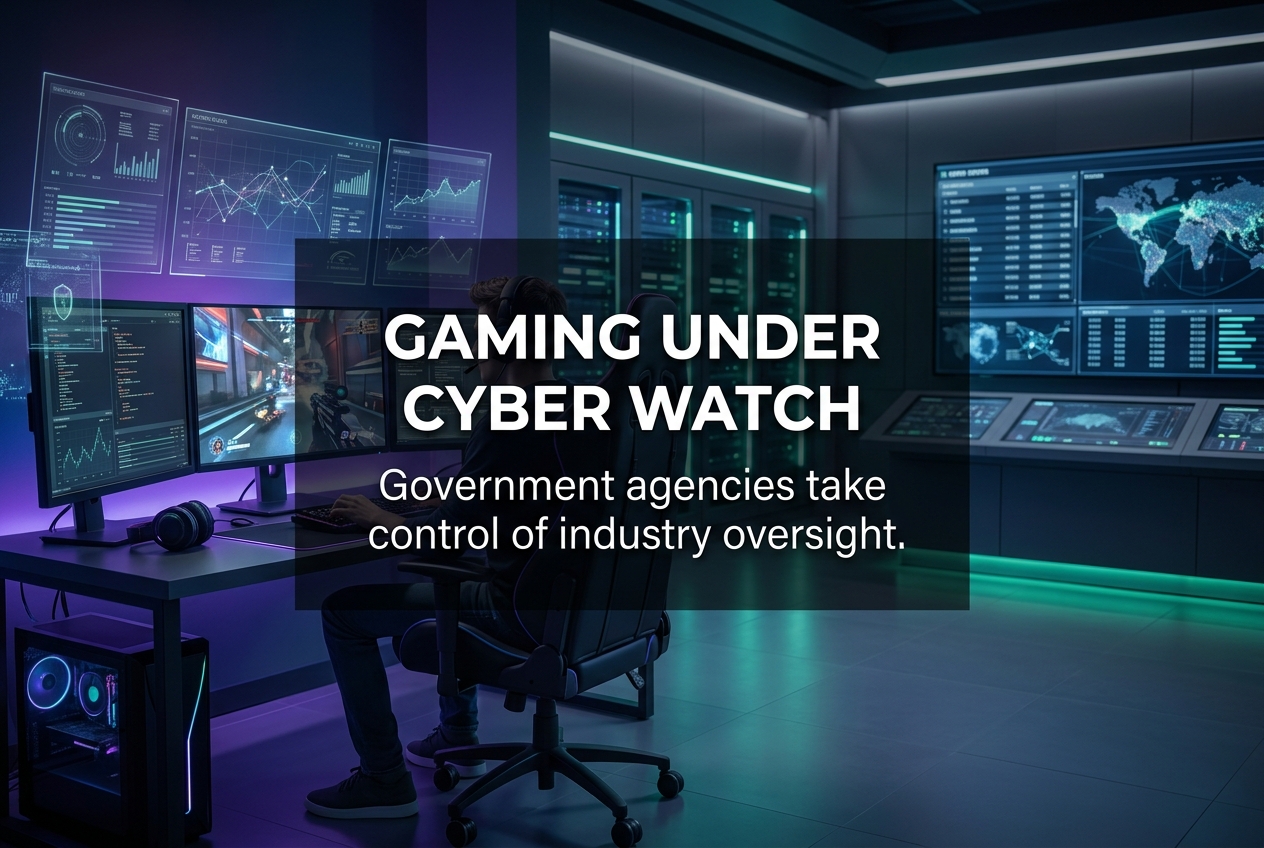
Countries are increasingly routing gaming industry oversight through dedicated cybersecurity authorities. Turkey’s latest move mirrors a wider global shift that touches data security, player protection, and platform accountability.
Governments are increasingly placing gaming industry oversight under the direct authority of dedicated cybersecurity bodies. Turkey’s parliament is currently reviewing legislation that would transfer all cyber-related powers from its telecoms regulator (BTK) to a new presidential Cyber Security Authority, making it the primary point of contact for game publishers and platforms on data security, threat management, and digital safety standards. This is not an isolated move: across the EU and beyond, cybersecurity frameworks are rapidly expanding to cover the gaming sector in ways that would have been unimaginable five years ago.
What Is Happening in Turkey?
A 30-article omnibus bill submitted to Turkey’s Grand National Assembly (TBMM) in early July 2026 proposes transferring strategic cybersecurity functions from the Information and Communication Technologies Authority (BTK) to a Cyber Security Authority established under the Turkish presidency in 2025. The transferred powers include internet domain policy, critical cyber-measure decisions, data centre directives, communications interception and analysis, and all specialist cybersecurity personnel and infrastructure previously housed within BTK.
For the gaming industry specifically, this means game developers and publishers operating in Turkey will now deal with the Cyber Security Authority, rather than BTK, on matters including user data management, cyber threat protection mechanisms, and digital security standards. Turkey’s gaming market reached $1.01 billion in 2025 after 25% year-on-year growth, making it a significant regional market that global publishers cannot afford to ignore.
This shift comes on top of Law No. 7578, published in Turkey’s Official Gazette on 1 May 2026, which for the first time legally defines “game”, “game developer”, “game distributor”, and “game platform”. The law’s gaming provisions enter into force on 1 November 2026, introducing age-rating requirements, mandatory parental controls, local representative obligations for foreign platforms with over 100,000 daily Turkish users, and a graduated sanctions regime with fines ranging from TRY 1 million to TRY 30 million and bandwidth throttling of up to 50%.
Why Are Cybersecurity Bodies Getting Involved in Gaming?
The gaming industry generates massive volumes of personal data, processes billions in digital transactions, and serves an audience that skews younger than almost any other digital sector. These characteristics make gaming platforms high-value targets for cyberattacks and natural candidates for cybersecurity oversight. Player account theft, credential stuffing, DDoS attacks on game servers, and in-game economy fraud are daily realities for both studios and players.
As governments centralise their cyber-defence architectures, gaming inevitably falls within scope. A dedicated cybersecurity authority can coordinate incident response, enforce data protection standards, and issue emergency measures faster than a traditional telecoms regulator juggling broadcasting, spectrum allocation, and internet governance at the same time.
The EU’s Expanding Cybersecurity Framework for Gaming
Europe is building what may be the world’s most comprehensive regulatory environment for the gaming industry. Several overlapping frameworks now directly or indirectly require gaming companies to meet cybersecurity standards:
Cyber Resilience Act (CRA): The CRA reclassifies games, whether distributed physically or digitally, as “products with digital elements.” This imposes lifecycle-wide cybersecurity requirements including conformity assessments and CE-marking. Vulnerability reporting obligations became mandatory in September 2026: developers must notify ENISA (the European Union Agency for Cybersecurity) immediately after detecting an actively exploited vulnerability. Full compliance is required by December 2027. Non-compliance can result in fines of up to EUR 15 million or 2.5% of global turnover. Crucially, security support must be guaranteed for at least five years.
NIS2 Directive: While the gaming sector is not explicitly listed among NIS2’s critical sectors, gaming companies can fall within scope through their reliance on cloud computing, data centres, and content delivery networks. NIS2 requires entities to implement risk management measures, report significant incidents to the national CSIRT within 24 hours, and submit detailed follow-up reports within 72 hours. Management bodies bear personal liability for cybersecurity compliance. Fines can reach EUR 10 million or 2% of global annual turnover for essential entities.
Digital Services Act (DSA): Fully applicable since February 2024, the DSA treats multiplayer games hosting user-generated content as “online platforms,” bringing them under content moderation, transparency reporting, and dark-pattern prohibition rules. Very Large Online Platforms (those with 45 million+ EU users) face additional obligations including systemic risk assessments and independent audits. Companies violating the DSA can face fines of up to 6% of global turnover.
How Does This Affect Game Developers and Publishers?
The practical impact is significant. Studios and publishers now face concurrent obligations across multiple regulatory layers. A European game developer releasing a live-service title must simultaneously comply with CRA vulnerability reporting, DSA content moderation requirements, GDPR data protection rules, and potentially NIS2 incident reporting if their infrastructure relies on in-scope cloud or data centre services.
Key compliance actions include:
- Maintaining a Software Bill of Materials (SBOM) listing all components, including open-source libraries
- Implementing proactive “security by design” rather than reactive patching
- Establishing 24-hour incident reporting pipelines
- Providing transparent notice-and-action mechanisms for illegal content
- Ensuring parental control tools are accessible and effective
- Training C-suite executives on cybersecurity governance, as personal liability is now on the table
For foreign-based developers, markets like Turkey are adding local representative requirements and region-specific sanctions. The trend toward jurisdiction-level enforcement means that operating cross-border without local compliance infrastructure is becoming increasingly risky.
What About Player Safety and Account Security?
For players, the shift toward cybersecurity-led oversight has direct benefits. Centralised cybersecurity authorities can respond to large-scale breaches faster, enforce stronger data protection standards, and coordinate with international partners more effectively than fragmented regulators.
Age-verification requirements, mandatory parental controls, and in-game spending transparency are becoming standard across jurisdictions. Turkey’s new framework requires platforms to enable parental approval for purchases and subscriptions. The EU’s upcoming Digital Fairness Act (expected to be formally proposed in Q4 2026) may go further by requiring games to display the real-world monetary equivalent of virtual currency at the point of purchase.
Players who buy, sell, or trade game accounts and digital items should prioritise platforms with verified security systems and transparent processes. GamerMarkt, for example, offers practical guidance on account security when buying game accounts.
What Comes Next for Global Gaming Regulation?
The direction is clear: cybersecurity is no longer a backend concern that gaming companies can delegate to IT departments. It is becoming a board-level compliance obligation with real financial and legal consequences.
Several developments to watch in the second half of 2026 and into 2027:
- Turkey’s November 2026 deadline: Foreign gaming platforms must appoint local representatives and comply with age-rating and parental control obligations.
- EU CRA full compliance (December 2027): All digital products, including games, must meet lifecycle cybersecurity requirements with CE-marking.
- Digital Fairness Act proposal (Q4 2026): Could regulate addictive design, dark patterns in monetisation, and virtual currency transparency in games.
- NIS2 national implementations: Several EU member states are still transposing the directive into national law, with the Netherlands expecting enforcement from Q2 2026.
For game developers, publishers, and platform operators, the message is straightforward: cybersecurity compliance is now a market-access requirement, not an optional investment. Studios that build security into their development pipeline from day one will spend less on compliance in the long run and face fewer regulatory surprises. For players, these changes promise stronger data protection, safer transactions, and more transparent digital environments.