
Sony’s April 2026 PlayStation Terms of Service update gives the company the right to close PSN accounts inactive for 36 months, permanently deleting all digital games and purchases. With physical discs ending in 2028, the stakes have never been higher.
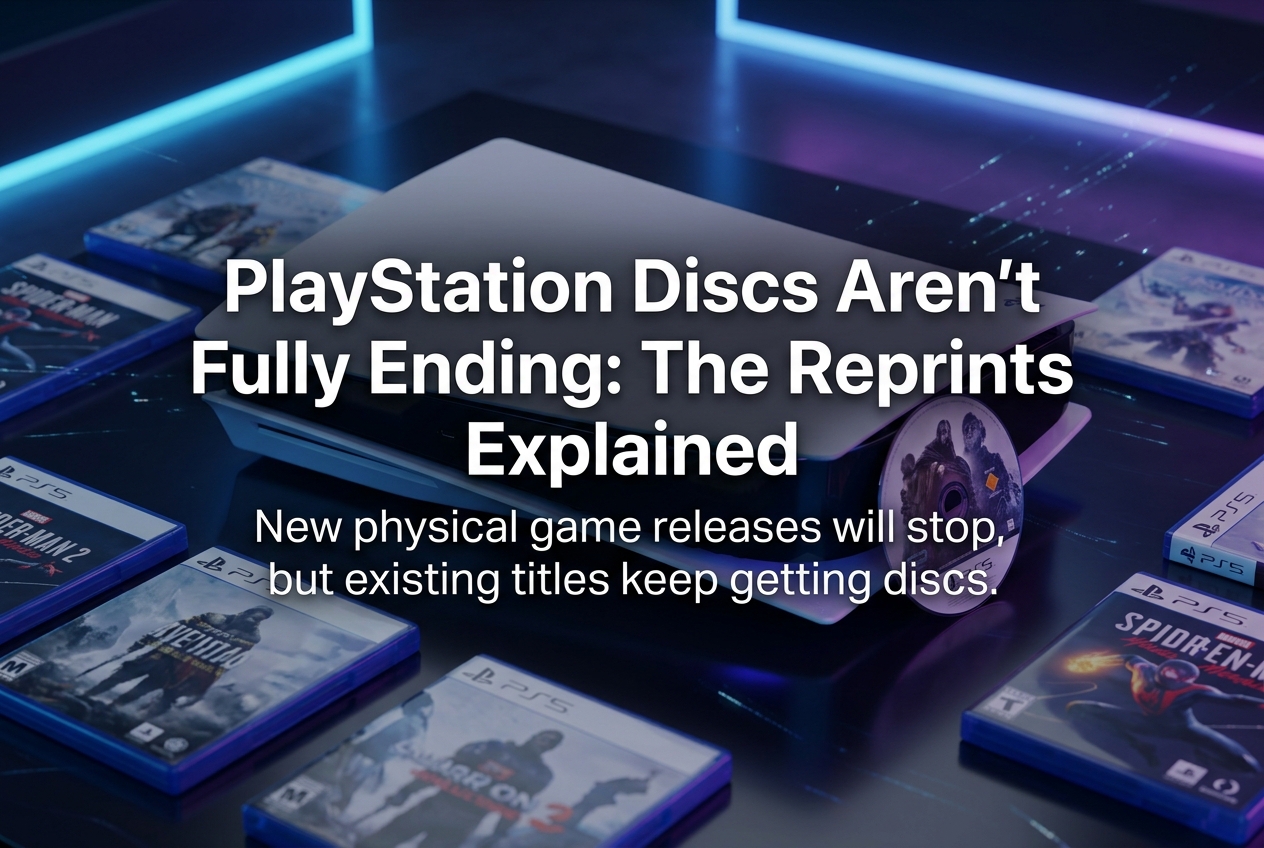
Sony updated its PlayStation Terms of Service in April 2026, and Section 21.2 now explicitly grants the company the right to close PSN accounts that have been inactive for 36 months. Once an account is closed, all digital games, DLC, films, and other purchased content tied to it are permanently lost. The timing of this discovery could not be worse: Sony announced on July 1, 2026, that physical disc production for all new PlayStation games will end in January 2028.
What Does Section 21.2 Actually Say?
The exact wording from Sony’s Terms of Service reads: “If you have not used your Account for at least 36 months we may take steps to close it. In that case, we will contact you via the email address registered to your Account and give you 6 months to either log in to your Account or contact us and tell us to keep your Account open.”
Section 21.3 then delivers the consequence: “After your Account is closed, you will not be able to access the PlayStation Online Services or use the Digital Products purchased with that Account. Account closure is irreversible.”
The key word here is “may.” Sony is not required to delete inactive accounts. It simply reserves the right to do so. As of July 2026, no documented cases of accounts being deleted under this provision have been reported. But the legal framework is in place whenever Sony chooses to act on it.
Which Regions Are Affected?
The 36-month inactivity clause primarily applies to European accounts, including the UK, EU member states, and several other territories. It has actually been present in European PSN agreements for several years, though most players never noticed it until the physical disc controversy brought new scrutiny to the Terms of Service.
In the United States, the equivalent ToS does not include the same inactivity-based closure provision. US accounts face no deletion risk from inactivity alone, as long as users have not violated other sections of the agreement. Some Asian-region agreements, such as Indonesia, have an even shorter threshold of 24 months.
Why the Physical Disc Decision Made This Much Worse
Sony’s July 1, 2026, announcement confirmed that all new PlayStation games released after January 2028 will be digital-only. No more Blu-ray discs. Physical retail copies will contain only download codes. The PlayStation 6 is widely expected to ship without a disc drive entirely.
This fundamentally changes the risk calculus for every PlayStation player. When physical discs existed, your game library had a tangible, independent backup. You could sell, lend, or replay those discs on any compatible console without needing an active PSN account. In an all-digital future, every game you buy is a license bound to your PSN account. If that account is closed, everything goes with it.
A Change.org petition titled “Don’t Kill the Disc: Tell Sony to Keep Physical PlayStation Games” has gathered over 110,000 signatures as of July 6, 2026, reflecting the scale of community opposition.
The 551 Deleted Movies Set the Precedent
In late June 2026, Sony confirmed that 551 StudioCanal films and TV shows previously purchased by UK PlayStation Store users would be removed from their libraries on September 1, 2026. No refunds. No compensation. The content simply disappears.
PlayStation’s own Terms of Service explain why this is legally possible: “When you order or purchase a product from PlayStation Store, you buy a personal license to use that product for private, non-commercial use. That license is not transferable. This means you can use a product in the ways described in the license, but do not own the product.”
For many players, the StudioCanal removal was the clearest proof yet that digital purchases are revocable licenses, not permanent ownership. Combined with the inactive account clause, the message is stark: Sony can both remove the content itself and close the account that held it.
How Does Microsoft Handle Inactive Accounts?
Microsoft also reserves the right to close inactive accounts, but the conditions differ. Microsoft accounts face potential closure after 2 years of inactivity, while Xbox Gamertags are released back into circulation after 5 years without a login. However, Microsoft’s policy generally protects accounts that have purchase history or active subscriptions.
Sony’s 36-month rule does not include an explicit exception for accounts with digital purchases. In theory, an account with hundreds of euros worth of games could still be closed if the owner fails to log in for three years and does not respond to Sony’s email notification within six months.
How to Protect Your PSN Account
The good news: staying safe requires minimal effort. Here is what you should do:
- Log in periodically. A single login resets the inactivity timer. Even once a year is more than enough to stay well within the 36-month window.
- Keep your email address current. Sony sends the closure warning to your registered email. If that address is outdated or abandoned, you will miss the 6-month grace period entirely.
- Check secondary accounts. If you have old PSN accounts from the PS3 or PS Vita era that you no longer use, log into them at least once to keep them active.
- Consider physical copies while you can. For games releasing before January 2028, disc versions offer a hedge against digital-only risks.
- Enable two-factor authentication. This does not directly prevent inactivity closure, but it protects your account from unauthorized access, which could lead to a different type of suspension.
The Class Action Waiver Adds Another Layer
Sony’s Terms of Service also include a mandatory binding individual arbitration clause and class action waiver, currently found in Section 14 of the US agreement. This means players who accept the ToS give up their right to participate in class action lawsuits against Sony. Disputes must be resolved individually through arbitration.
US-based players have a 30-day window after accepting the Terms to opt out of the arbitration clause by sending a written letter to Sony’s legal department in Los Angeles. European consumer protection laws may override some of these provisions depending on the jurisdiction, but the clause itself demonstrates how aggressively Sony has structured its legal protections.
Things Players Keep Asking
Has Sony actually deleted anyone’s account for inactivity?
No. As of July 2026, there are no publicly documented cases. The rule exists as a reserved right, not an actively enforced policy. But reserved rights can become active policies at any time.
Does having a PS Plus subscription protect my account?
There is no explicit exemption in the ToS for accounts with active subscriptions. However, an active subscription inherently means the account is being used, so the inactivity clock would not start ticking.
What about my wallet balance?
Gone. When an account is closed, unused wallet funds, unexpired subscriptions, and all digital content access are terminated. Sony states it will not refund these unless required to do so by law.
Can I transfer my digital games to another account before closure?
No. PlayStation digital licenses are non-transferable and tied to a single PSN account. There is no mechanism to move purchases between accounts.
Is this legal under EU consumer protection law?
The legality is debatable. EU consumer protection rules are generally stronger than their US counterparts, and there are ongoing discussions about digital ownership rights. A class action lawsuit against Sony regarding PlayStation Store pricing and consumer rights is already being heard in the UK courts as of March 2026. How these broader legal challenges affect the inactivity clause remains to be seen.
The Bigger Picture: You Do Not Own Your Digital Games
Sony’s last few weeks have been a cascade of consumer trust failures. The StudioCanal removals, the end of physical discs, the PS3 and PS Vita store closures, and now the spotlight on inactive account deletion all point to the same uncomfortable truth: digital purchases on PlayStation are revocable licenses, not permanent property.
The gaming industry has been moving toward this reality for years, but Sony has made it impossible to ignore. When a company can remove content you paid for, close the account that holds your library, and eliminate the physical format that once served as a fallback, the power imbalance between platform and player becomes absolute.
For now, the 36-month inactivity rule remains a theoretical risk rather than an active threat. But theoretical risks have a way of becoming real ones once the infrastructure to enforce them is fully in place. The simplest defence: log in, keep your email updated, and pay attention to what you agree to.