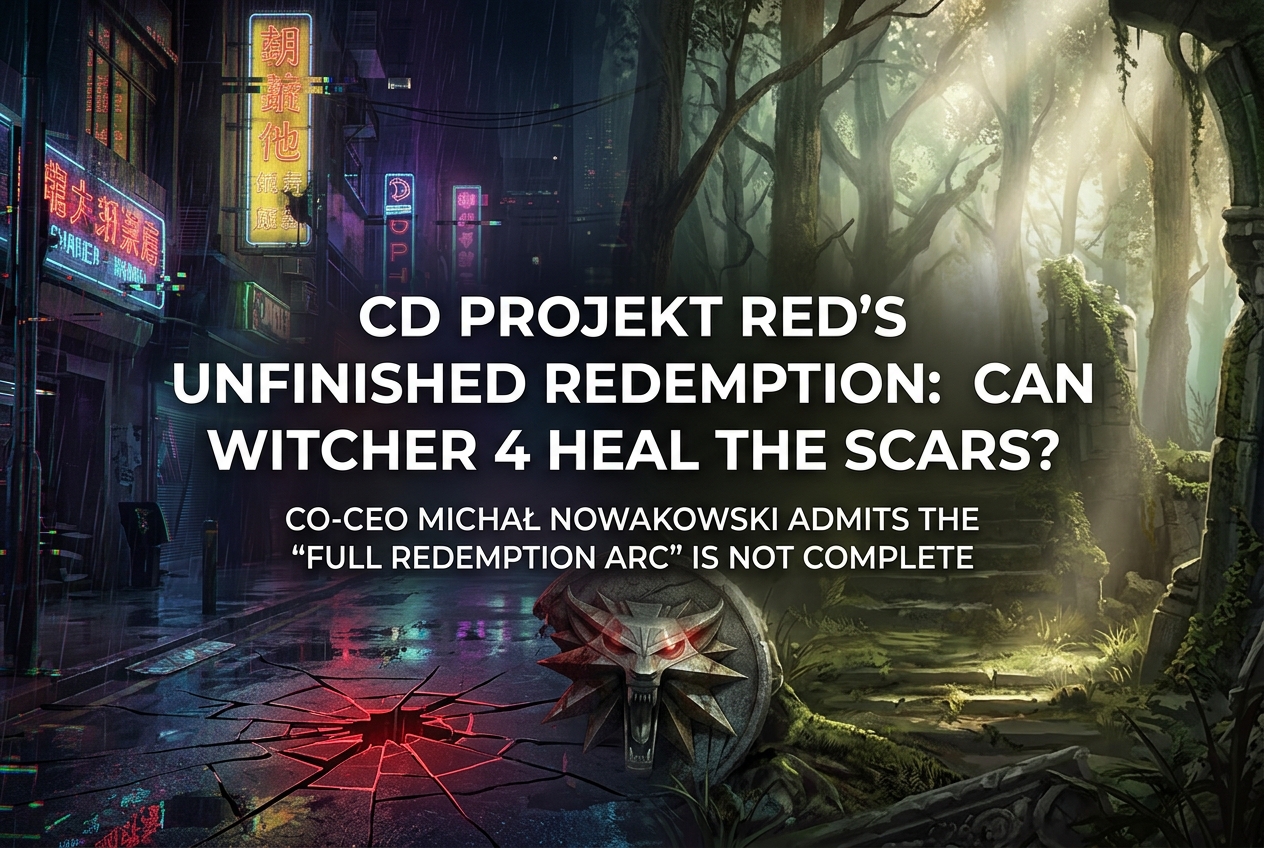
CD Projekt Red co-CEO Michał Nowakowski admits the studio has not completed its “full redemption arc” after Cyberpunk 2077 and hopes The Witcher 4 can win back lost players.
CD Projekt Red co-CEO Michał Nowakowski has openly admitted that the studio has not yet completed its “full redemption arc” after the disastrous launch of Cyberpunk 2077 in December 2020. In an interview published in Edge’s Knowledge newsletter, Nowakowski called the launch a “heartbreaking” period and revealed that some players’ trust has been lost “indefinitely,” a consequence he considers fair. He now pins his hopes on The Witcher 4 to begin earning that trust back.
What Nowakowski Actually Said
“I’m not 100 percent convinced we went through the full redemption arc,” Nowakowski told Edge, as reported by GamesRadar. “I’m convinced that we lost the faith of some people indefinitely, and that’s a fair thing. But I do hope we will be able to make it back, if not with The Witcher 4, then with whatever comes next.”
This level of candor is uncommon in the games industry. Studios typically retreat behind carefully worded statements about “lessons learned.” Nowakowski instead concedes that a portion of the audience is gone for good, and rather than treating it as a PR problem, he treats it as a natural consequence of what happened in 2020. That kind of honesty raises the stakes for everything CDPR releases next.
Why Cyberpunk 2077’s Launch Became a Cautionary Tale
When Cyberpunk 2077 launched in late 2020, it was barely functional on last-generation consoles. PS4 and Xbox One players encountered critical bugs, frequent crashes, severe performance drops, and features that had been trimmed from what years of marketing had promised. Sony took the unprecedented step of removing the game from the PlayStation Store entirely and offering full refunds.
The fallout was devastating for a studio that had spent years building one of the strongest reputations in gaming. The Witcher 3: Wild Hunt, released in 2015, had cemented CDPR as a beloved developer that prioritized quality. Cyberpunk 2077 burned through that goodwill in days. Although the game quickly recouped its development and marketing costs, the reputational damage ran deep.
35 Million Copies Sold, Yet Trust Remains Fractured
In the nearly six years since launch, Cyberpunk 2077 has undergone a substantial transformation. A steady stream of patches reworked core systems, and the 2023 Phantom Liberty expansion noticeably shifted both critical reception and player sentiment. The game has now surpassed 35 million copies sold in under five years, making it one of the best-selling RPGs of its generation.
But Nowakowski clearly understands a truth that sales figures alone cannot capture: commercial success does not erase reputational debt. Many players bought the game out of curiosity, hype, or brand loyalty without ever forgiving the studio for the state it launched in. The paradox at the heart of Cyberpunk 2077 is that it became a commercial triumph and a trust failure at the same time.
What We Know About The Witcher 4
The Witcher 4, codenamed Project Polaris, is the first game in a planned new Witcher trilogy. CDPR officially announced the project in 2022, revealed its first cinematic teaser at The Game Awards 2024 confirming Ciri as the protagonist, and showcased a technical demo built in Unreal Engine 5 during Epic’s State of Unreal event in June 2025.
Key confirmed details include:
- Protagonist: Ciri replaces Geralt as the lead character, with Geralt voice actor Doug Cockle confirmed to appear in some capacity.
- Engine: CDPR has moved from its proprietary REDengine to Unreal Engine 5, incorporating Nanite geometry, Lumen lighting, and NVIDIA’s RTX Mega Geometry technology.
- Combat: Leaked details suggest Ciri’s Elder Blood powers will feature multiple skill trees covering teleportation, time manipulation, and area-of-effect abilities.
- Platforms: The game is expected to launch simultaneously on PC and consoles, a deliberate shift from the cross-generation approach that contributed to Cyberpunk 2077’s problems.
- New trilogy: CDPR aims to release three new Witcher games within a six-year window following The Witcher 4’s launch.
When Will The Witcher 4 Release?
CDPR has officially confirmed that The Witcher 4 will not launch in 2026. During an earnings call, CFO Piotr Nielubowicz stated: “All we could share now to give more visibility to investors is that the game will not be launched within the time frame of the first target for the incentive program, which ends December 31, 2026.” This puts 2027 as the earliest realistic release window, with some analysts and content creators suggesting 2028 remains possible depending on development progress.
The absence of a firm release date itself reads as a deliberate signal. Since 2020, CDPR has clearly moved away from committing to dates before the team is confident a game is ready. Nowakowski reinforced this approach in the same Edge interview, noting that the studio would use shorter, more focused marketing campaigns rather than the drawn-out hype cycle that preceded Cyberpunk 2077.
CDPR’s Full Project Pipeline in 2026
The Witcher 4 is not the only project keeping CD Projekt Red busy. The studio’s current slate includes several titles designed to maintain IP visibility and spread risk across multiple releases:
- Songs of the Past: A full-scale narrative expansion for The Witcher 3: Wild Hunt, co-developed with Fool’s Theory, scheduled for 2027 on PS5, Xbox Series X/S, and PC. CDPR has described it as a direct prelude to The Witcher 4.
- Cyberpunk 2 (Project Orion): The confirmed sequel to Cyberpunk 2077 entered pre-production last year. Analysts estimate a potential release around 2030.
- The Witcher Remake: A ground-up remake of the original 2007 Witcher game, quietly in development.
- Project Hadar: An entirely new IP from CDPR, still largely unrevealed.
- Witcher Multiplayer: A free-to-play PC and mobile RPG reportedly in early stages.
Nowakowski emphasized that despite this broader slate, CDPR does not intend to become a studio that ships a major game every year. “Our dream is to be making more games, although we never want to turn into the studio that’s going to be launching a big game every year,” he told Edge. “We have a rough ten-year rolling plan, but the goal is not to flood the games market with CDPR games. We just want to make really cool games.”
Can The Witcher 4 Actually Fix CDPR’s Reputation?
This is the core question hanging over the studio. The Witcher 4 is not merely the next entry in a beloved franchise. It is a definitive test of whether CDPR can deliver consistent quality or whether Cyberpunk 2077’s troubled launch was a symptom of something systemic rather than a one-time mistake.
If The Witcher 4 launches smoothly and meets expectations, the “Cyberpunk was an outlier” narrative holds. If problems surface again, the conversation shifts permanently toward structural issues with how the studio builds and ships games. CDPR’s own leadership seems acutely aware of this dynamic, which is likely why they are refusing to rush toward a release date.
There are encouraging signs. The Unreal Engine 5 tech demo shown in 2025 demonstrated impressive visual fidelity running on base PS5 hardware at 60fps with ray tracing. A former Larian Studios developer who joined CDPR to work on The Witcher 4 stated after six months that “people are not ready for it,” suggesting strong internal confidence. The studio has also retained over half of the developers who worked on the original Witcher trilogy, an unusually high retention rate for the games industry.
What Players Should Take Away From This
Nowakowski’s admission is a rare moment of corporate honesty in an industry that tends to avoid this kind of language. The practical takeaways are straightforward:
- Base expectations on post-launch reviews, not trailers or pre-release promises.
- Pre-ordering The Witcher 4 at launch carries real risk, especially for players who experienced Cyberpunk 2077 on day one.
- Phantom Liberty proved CDPR can fix its own mistakes, but that recovery took years, not a single patch.
- The deliberate absence of a firm release date suggests the studio has internalized the lesson of not shipping before a game is ready.
Whether The Witcher 4 actually wins back the skeptics will depend entirely on its launch quality and the first few weeks after release. Just as with Cyberpunk 2077, the launch window is where reputations are made or broken. CDPR appears to understand this better than most, but understanding the stakes and delivering on them are two very different things.
Questions Players Keep Asking
Is Geralt in The Witcher 4?
Geralt is no longer the protagonist. Ciri takes the lead role, but Doug Cockle, who voices Geralt, is confirmed to be involved in the project. Geralt will likely appear in some form, but the story centers on Ciri and what appears to be the School of the Lynx, a new Witcher school she founds after the events of The Witcher 3.
Why did CDPR switch from REDengine to Unreal Engine 5?
CDPR’s VP of technology Charles Tremblay explained that the switch was driven by the ability to share expertise and leverage Epic’s broader development ecosystem. The decision was not directly motivated by Cyberpunk 2077’s technical failures, but rather by the long-term benefits of working within a widely supported engine framework. The June 2025 tech demo showcased Nanite, Lumen, and advanced NPC animation systems.
Will The Witcher 4 have expansions?
CDPR has indicated that creating expansion content for The Witcher 4 “would be difficult” given the studio’s ambitious plan to deliver three full Witcher games within six years. The focus appears to be on shipping complete base games rather than extending them with post-launch DLC.
What is Songs of the Past?
Songs of the Past is a newly announced full-scale premium expansion for The Witcher 3: Wild Hunt, developed jointly by CDPR and Fool’s Theory. It was originally planned for 2026 but was delayed to 2027 to meet quality standards. CDPR has confirmed it serves as a direct narrative prelude to The Witcher 4, bridging the story between the two games.