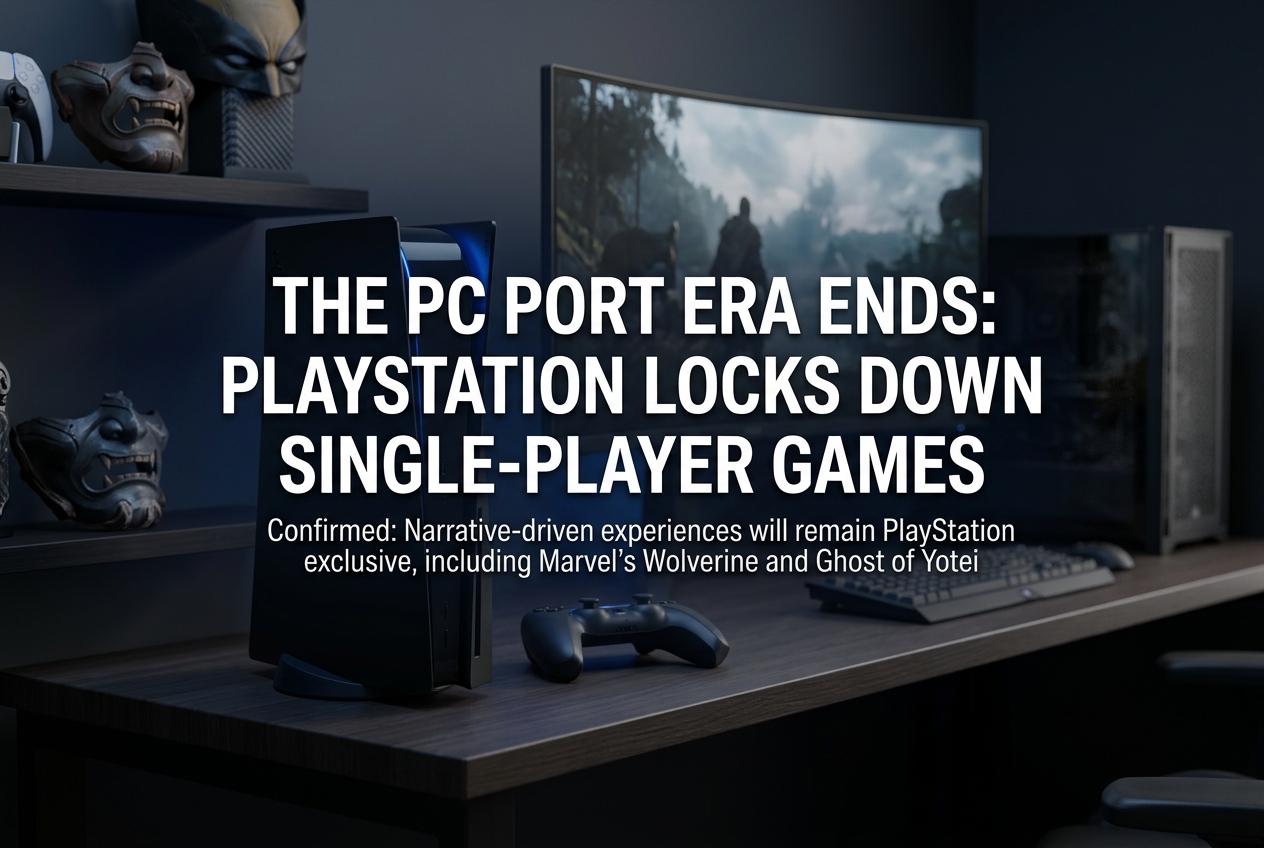
Sony Interactive Entertainment has officially reversed its PC porting strategy, ending a six-year experiment that began in 2020 and generated over $2 billion in revenue. PlayStation Studios CEO Hermen Hulst confirmed the decision during an internal town hall meeting on May 18, 2026, telling staff that all narrative-driven single-player games will remain exclusive to PlayStation consoles going forward. The announcement, first reported by Bloomberg journalist Jason Schreier, means titles like Marvel’s Wolverine, Ghost of Yotei, and Intergalactic: The Heretic Prophet will never arrive on PC.
What Exactly Did Hermen Hulst Say?
According to Schreier’s posts on the ResetEra forum, Hulst laid out three core reasons for the shift during the company-wide meeting. He stated that PlayStation’s PC releases had been “inconsistent,” failed to generate sufficient revenue, and that Sony wants its intellectual properties tied to its own platform. Schreier confirmed the details with two individuals who were present at the meeting and emphasized there would be no “case by case” evaluation for future titles.
This was not a surprise announcement. Schreier had first signalled the change during an appearance on the Triple Click podcast in February 2026, where he noted: “The sense I’m getting is that they’re backing away from putting their exclusive console stuff, like traditional single player stuff, on PC.” A full Bloomberg report followed in March, confirming that Ghost of Yotei’s PC port had been scrapped and that Saros would remain PS5-exclusive.
Which Games Are Affected?
The policy covers all future first-party single-player narrative games from PlayStation Studios. The most high-profile titles confirmed as PS5-only include:
- Marvel’s Wolverine (Insomniac Games): Launching September 15, 2026, exclusively on PS5. No PC version is planned.
- Ghost of Yotei (Sucker Punch): The Ghost of Tsushima sequel’s PC port was actively cancelled.
- Saros (Housemarque): Already released as a PS5 exclusive with no PC plans.
- Intergalactic: The Heretic Prophet (Naughty Dog): Will remain PlayStation-only.
Two previously announced titles will still arrive on PC: Death Stranding 2: On the Beach and Kena: Scars of Kosmora. Both were already far along in their PC development pipelines when the decision was made, and they are expected to be the final Sony-published single-player games to reach the platform.
Live-Service Games Are Exempt
Sony drew a clear line between narrative single-player experiences and multiplayer or live-service titles. Games designed around ongoing player engagement will continue to launch across platforms. Marathon, Marvel Tokon: Fighting Souls (launching August 6, 2026 on PS5 and PC simultaneously), and Helldivers 2 all fall outside the new exclusivity mandate. The reasoning is straightforward: live-service games need the largest possible player base to sustain their economies and matchmaking systems.
Why Did Sony Pull Back From PC?
Multiple factors drove the decision, and the evidence gathered from Bloomberg reports, Schreier’s commentary, and Sony’s own filings paints a comprehensive picture.
Revenue fell short of expectations. According to Push Square’s analysis, PC ports accounted for roughly 1.5% of PlayStation’s total revenue over the four years since the strategy launched in earnest. Much of that was driven by the runaway success of Helldivers 2, a multiplayer title. Single-player ports like Horizon Forbidden West and The Last of Us Part II performed modestly by comparison.
Late releases killed momentum. Sony’s approach of waiting one to two years after a console launch before releasing a PC version meant games arrived on Steam after initial hype had faded. Player interest in new single-player titles typically drops by approximately 60% within the first five weeks, making delayed ports an inherently disadvantaged product.
The next Xbox changed the calculus. Microsoft’s upcoming console, widely reported to function more like a gaming PC with access to multiple storefronts including Steam, alarmed Sony executives. The prospect of PlayStation’s premier titles running on Xbox-branded hardware through PC storefronts was reportedly a significant concern.
PSN integration failed on PC. Sony attempted to bring PC players into its PlayStation Network ecosystem, but faced massive backlash when it tried to mandate PSN account logins on Steam. The company was forced to make logins optional after the Helldivers 2 controversy, where players in over 100 countries lost access. This undermined the strategic value of reaching PC audiences.
Console exclusivity protects hardware sales. With PS6 not expected until around 2030, Sony needs strong PS5 exclusives to maintain the console’s relevance and drive continued hardware adoption. Nintendo’s success with strict exclusivity served as a compelling proof point.
Sony’s SEC Filing Confirms the Shift
Perhaps the most concrete evidence came from Sony’s own regulatory documents. Game File discovered that Sony’s 2025 annual report filed with the U.S. Securities and Exchange Commission contained a line stating the company would “continue efforts to deploy its first-party titles to multiple platforms such as PC.” That sentence was entirely removed from the 2026 report, a 229-page document that replaces the PC commitment with increased emphasis on AI integration. This deletion represents Sony’s official admission by omission.
Around the same time, PlayStation Studios’ official website was updated to remove PC references from most studio profiles. Only Nixxes Software, the company’s dedicated PC porting studio, retained mentions of the platform.
What Happens to Nixxes Software?
Sony acquired the Dutch studio Nixxes Software in July 2021 specifically to handle PC port development. Nixxes had previously built a strong reputation porting Crystal Dynamics titles including the Tomb Raider trilogy and Deus Ex: Mankind Divided. Under Sony, it worked on PC versions of several PlayStation exclusives.
With single-player PC ports ending, Nixxes faces an uncertain future. The studio is currently completing the Death Stranding 2 PC port and providing additional development support on Saros. However, once those projects wrap, its primary function within Sony’s structure effectively disappears. Given Sony’s recent closure of Bluepoint Games, another acquired studio, industry observers have noted the parallel with concern. Sony has not commented on Nixxes’ future.
The Six-Year Experiment in Numbers
Sony’s PC porting journey began in August 2020 when Horizon Zero Dawn launched on Steam. Over the following years, a steady stream of PlayStation’s most celebrated titles made the jump: God of War (2022), Marvel’s Spider-Man Remastered (2022), Uncharted: Legacy of Thieves Collection (2022), The Last of Us Part I (2023), Ghost of Tsushima (2024), and Marvel’s Spider-Man 2 (2025), among others.
The initiative generated over $2 billion in combined PC revenue. However, when measured against PlayStation’s total revenue, which is heavily driven by the 30% cut from third-party sales, subscriptions, and microtransactions on the PlayStation Store, the first-party PC contribution remained a fraction of overall income. Sony clearly decided the strategic risks outweighed the financial returns.
What This Means for PC Gamers
For players who relied on eventual PC ports to experience PlayStation’s biggest games, the message is unambiguous: that pipeline is closing. Existing PlayStation titles already available on Steam will remain accessible, but no new single-player additions are coming.
Playing Marvel’s Wolverine when it launches in September, or Ghost of Yotei, or any future Naughty Dog game, will require owning a PS5 or a future PlayStation console. For PC-only gamers, this effectively re-establishes the console purchase barrier that Sony spent six years gradually lowering.
The exception remains multiplayer and live-service games, which will continue arriving on PC. But the era of waiting a year or two for God of War or Spider-Man to show up on Steam is over.
Questions Gamers Are Asking
Will Marvel’s Wolverine ever come to PC?
No. Hermen Hulst explicitly confirmed on May 18, 2026 that Marvel’s Wolverine will be a permanent PS5 exclusive. The game launches September 15, 2026, with no PC version planned at any point.
Are existing PlayStation games being removed from Steam?
No. Games already released on PC, including God of War, Spider-Man, Ghost of Tsushima, and others, will remain available for purchase and play. The policy affects only future titles.
Will Helldivers 2 and similar games stay on PC?
Yes. Multiplayer and live-service games are exempt from the exclusivity decision. Marathon, Marvel Tokon: Fighting Souls, and Helldivers 2 will continue to be supported on PC.
Could Sony reverse this decision later?
It is possible but unlikely in the near term. Bloomberg’s reporting noted that “future plans might evolve,” but the combination of Hulst’s definitive internal messaging, the SEC filing changes, and the website updates all point to a firm strategic commitment. Any reversal would likely depend on significantly changed market conditions, possibly around the PS6 launch window.
What about third-party games published by Sony?
Games developed by external studios but published by Sony, such as Death Stranding 2 and Kena: Scars of Kosmora, appear to be handled differently. Both are still coming to PC. However, it is unclear whether future third-party partnerships will follow the same exception or be pulled into the new exclusivity model.
A Strategic Return to Console-First Identity
Sony’s decision marks a deliberate return to the console-centric identity that defined PlayStation for over two decades before the PC experiment began. The move mirrors Nintendo’s longstanding approach of keeping first-party titles locked to its own hardware, a strategy that has proven commercially successful generation after generation.
For Sony, the bet is clear: exclusive games sell consoles, and selling consoles creates an ecosystem where the real money flows through PlayStation Store purchases, PS Plus subscriptions, and third-party revenue shares. The $2 billion earned from PC ports, while significant in isolation, represented a strategic distraction from that core flywheel. Whether this gamble pays off through the remainder of the PS5’s lifecycle and into the PS6 era remains to be seen, but Sony has made its choice with unmistakable finality.